


Coverage Period: June 1–30, 2026
Published: July 2026
Editor’s Note – July 2026 Issue
The July 2026 Issue of First Watch Energy – Monthly Pulse reflects a global oil and gas system moving from acute disruption pricing toward a more selective test of deliverable supply.
The June signal is not simply that risk declined; it is that the market began separating immediate crisis premium from the harder question of how reliably supply can return, move, and be delivered through exposed infrastructure.
June opened with elevated price sensitivity, geopolitical stress, LNG exposure, shipping uncertainty, and active concern around critical corridors. By month-end, the market tone had shifted toward recovery, normalization, and surplus risk, but not toward complacency.
Route security, operator execution, LNG deliverability, OPEC+ supply management, and demand resilience remain central indicators of confidence.
For decision-makers, the July issue frames the market around a practical distinction: capacity is useful only when it can be converted into deliverable supply. Producers, operators, and service companies are being measured less by headline scale and more by route optionality, infrastructure resilience, technical execution, and the ability to maintain momentum under volatility.
This edition is based on publicly available information, company disclosures, official data, market reporting, and First Watch Energy editorial analysis for the June 1–30, 2026 coverage period.
Executive Summary – From Risk Premium to Deliverability Reset
June 2026 marks a new stage for the global oil and gas system. The disruption framework that shaped the prior edition remains relevant, but the market moved from concentrated fear of supply shock toward a more complex balance between recovery, demand softness, producer strategy, and infrastructure confidence.
The most important signal is the shift from price premium to deliverability test. Brent and WTI moved lower from early-June stress levels as the market began pricing smoother flows and potential supply recovery. However, the decline in risk premium does not remove structural vulnerability. It simply changes the question from “what happens if supply is blocked?” to “how quickly and reliably can supply return?”
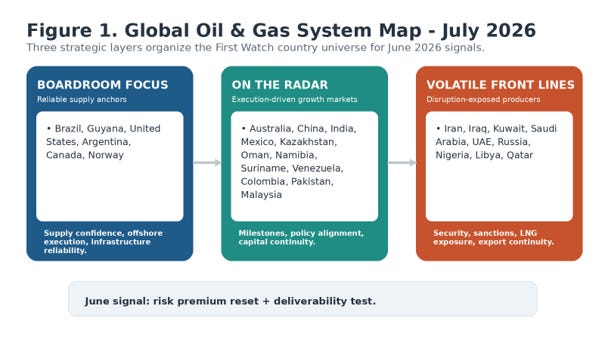
The Boardroom Focus group continues to provide the strongest baseline of supply confidence. Brazil, Guyana, the United States, Argentina, Canada, and Norway remain anchored by offshore execution, infrastructure depth, regulatory continuity, oil sands and shale resilience, and operator-led project delivery.
The On the Radar group remains the system’s conditional growth layer. Australia, China, India, Mexico, Kazakhstan, Oman, Namibia, Suriname, Venezuela, Colombia, Pakistan, and Malaysia retain strategic relevance, but credibility depends on milestones: LNG access, pipeline capacity, offshore drilling, licensing, sanctions, domestic policy, and capital continuity.
The Volatile Front Lines group remains the largest source of event-driven sensitivity. Iran, Iraq, Kuwait, Saudi Arabia, the UAE, Russia, Nigeria, Libya, and Qatar combine significant supply influence with elevated exposure to security, sanctions, route constraints, LNG disruption, political fragmentation, and export continuity risk.
Operator and service company activity reinforces the same conclusion. The market is rewarding execution capability. Supermajors, national oil companies, and service leaders are strongest where they can combine scale, technology, diversified geography, and project discipline.
In this environment, deliverability is becoming an execution advantage.
Strategic Supply Exposure Metric – Oil and LNG Coverage
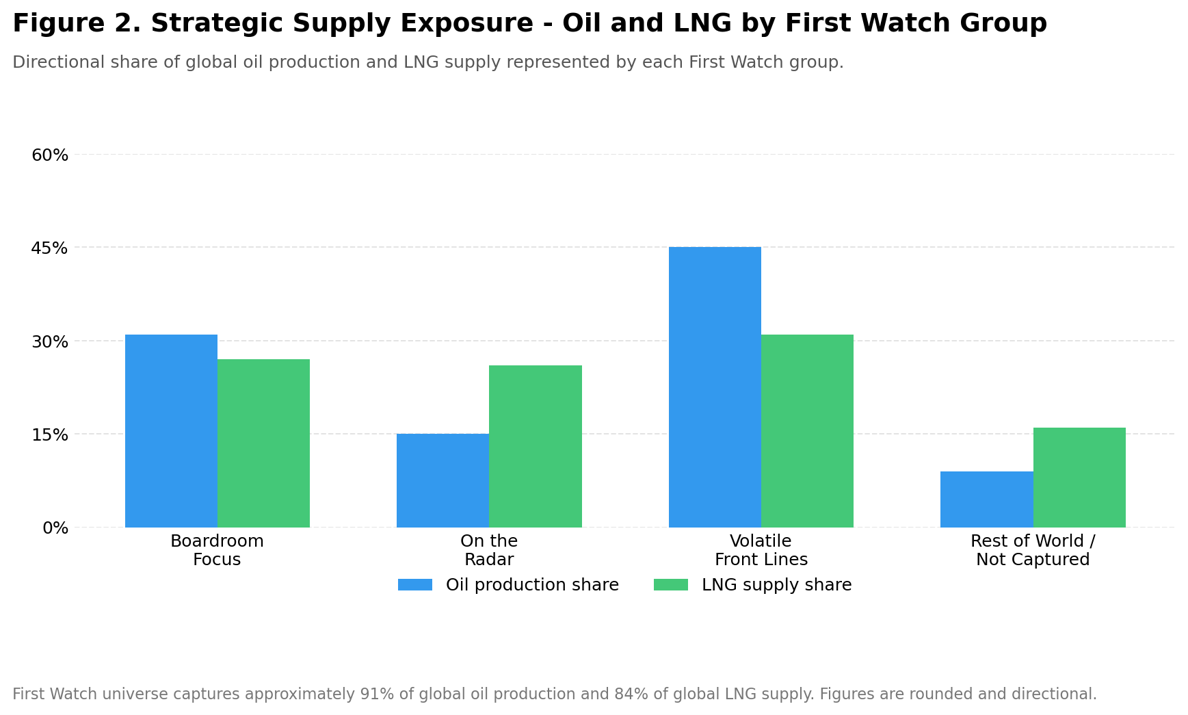
The Strategic Supply Exposure Metric remains a standing First Watch Energy lens. It shows how the 27-country First Watch universe maps against global oil production and LNG supply across Boardroom Focus, On the Radar, Volatile Front Lines, and Rest of World / Not Captured.
For the July 2026 Issue, the metric helps connect price behavior with structural exposure. The June market did not only react to barrels or cargoes; it reacted to where supply exposure sits, how much of that exposure is concentrated in disruption-sensitive producers, and how quickly capacity can become deliverable supply.
The First Watch universe captures approximately 91% of global oil production and 84% of global LNG supply on a directional basis. geography, and project discipline.
In this environment, deliverability is becoming an execution advantage.
Strategic Supply Exposure Metric – Oil and LNG Coverage
The Strategic Supply Exposure Metric remains a standing First Watch Energy lens. It shows how the 27-country First Watch universe maps against global oil production and LNG supply across Boardroom Focus, On the Radar, Volatile Front Lines, and Rest of World / Not Captured.
For the July 2026 Issue, the metric helps connect price behavior This reinforces why the framework is useful for reading market sensitivity: a large share of oil and LNG exposure sits inside the same country universe monitored through reliable anchors, execution-driven growth markets, and volatile front lines.
Month-over-month signal: Compared with the May 2026 edition, the July exposure profile remains broadly unchanged. This suggests that the First Watch country universe continues to capture the same structural concentration of oil and LNG exposure, while June market behavior was driven more by risk premium, route confidence, and deliverability than by a major reclassification of supply exposure.
Methodology Note: Supply exposure estimates are directional, rounded, and based on the latest available public crude oil, lease condensate, and LNG export/supply references. They are intended to support strategic interpretation of market exposure, price sensitivity, and deliverability risk.
Market Reset – From Crisis Pricing to Supply Recovery Test
The June market moved through two distinct phases. Early in the month, pricing and sentiment remained shaped by geopolitical exposure, Gulf shipping risk, LNG sensitivity, and uncertainty around critical corridors. By late June, the tone had shifted toward route reopening, supply recovery, and concerns that demand softness could reduce the durability of elevated prices.
Oil price behavior reflected this shift. Public market information indicates that Brent declined materially during June, while WTI also moved lower into the end of the month. The editorial implication is not that volatility ended, but that the market began discounting immediate crisis premium and focusing more on the speed and credibility of supply normalization.
OPEC+ remains central to this reset. The June 7 production increase decision, combined with demand revisions and recovery expectations, placed supply management back at the center of market interpretation. The market is now balancing producer discipline, physical recovery, inventories, and demand signals rather than pricing disruption alone.
LNG and natural gas remain structurally sensitive. Qatar and Gulf exposure, shipping risk, Asian LNG demand, European storage, and gas infrastructure all reinforce the First Watch deliverability theme. Gas supply confidence depends not only on resource availability or liquefaction capacity, but on the full chain from production to shipping to regasification.
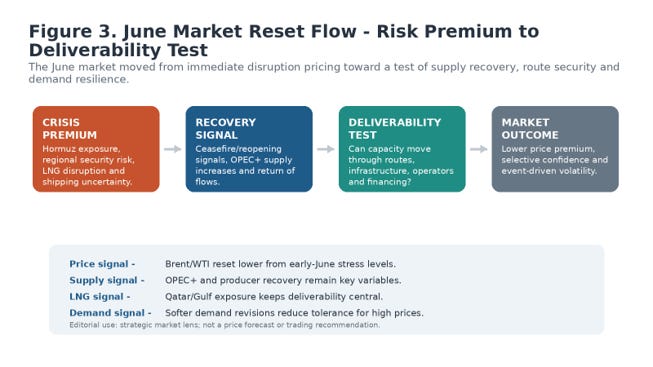
June Market Takeaway: The main signal is not simply lower prices. It is the shift from crisis premium toward a deliverability test: whether supply can move through routes, infrastructure, operators, and markets with enough confidence to sustain recovery.
Executive Outlook – Deliverability Under Selective Confidence
Looking ahead, the system is expected to remain selective rather than uniformly stable. Resilient producers can support baseline supply confidence, but disruption-exposed corridors, LNG routes, sanctions-sensitive markets, and OPEC+ decisions can still transmit quickly into prices and trade flows.
The Atlantic Basin continues to provide a stabilizing counterweight. Brazil and Guyana sustain deepwater growth momentum, the United States remains a major crude and gas platform, Argentina advances Vaca Muerta export optionality, Canada benefits from long-cycle production and infrastructure expansion, and Norway continues to represent low-noise offshore reliability.
Conditional growth markets will matter most where project milestones become visible. Mexico, Namibia, Suriname, Malaysia, Kazakhstan, Oman, China, India, Pakistan, Colombia, and Venezuela each offer strategic relevance, but their contribution depends on execution, policy alignment, financing, and infrastructure readiness.
The highest-risk layer remains concentrated around the Gulf, Russia, selected African producers, and LNG-sensitive flows. Even when immediate market stress fades, the system remains exposed to route security, export continuity, sanctions, political fragmentation, and the gap between nameplate capacity and deliverable supply.
For service companies, the clearest opportunity remains international execution. Offshore, unconventional completions, gas/LNG, digital optimization, managed-pressure drilling, subsea intervention, and complex well delivery are the strongest activity lanes. Service companies with integrated, technology-enabled execution models remain best positioned.
Executive Outlook Takeaway: The July issue emphasizes selective confidence: the market can recover, but confidence now depends on deliverability, execution quality, and route resilience, not only production capacity.
Boardroom Focus – Reliable Supply Anchors in a Resetting Market
The Boardroom Focus group remains the most reliable layer of the First Watch universe. These countries do not eliminate global volatility, but they provide the clearest combination of production visibility, infrastructure depth, operator execution, and planning-grade confidence.
Brazil and Guyana continue to define the strongest offshore growth corridor. Petrobras-led deepwater execution, FPSO activity, and pre-salt development keep Brazil central to the supply growth story, while ExxonMobil-led Stabroek activity reinforces Guyana as one of the highest-confidence frontier production platforms.
The United States remains a stabilizing force through crude production, natural gas depth, LNG relevance, Gulf of Mexico offshore activity, and Permian-linked resilience. Canada reinforces long-cycle reliability through oil sands discipline and export optionality. Norway remains a low-noise offshore anchor with regulatory consistency and mature-field redevelopment.
Argentina continues moving from emerging opportunity toward structural supply anchor. Vaca Muerta investment, pipeline build-out, YPF activity, Chevron/Shell participation, and Halliburton-supported completions activity all reinforce Argentina’s role as a high-relevance growth market for First Watch readers.
Boardroom Focus – Country Signals
Brazil – Petrobras-led offshore execution, FPSO expansion, pre-salt development, and international operator participation reinforce Brazil as a dependable growth engine.
Guyana – ExxonMobil-led Stabroek growth, FPSO expansion, and offshore execution maintain high confidence in future supply delivery.
United States – Crude production, LNG relevance, Permian activity, and Gulf of Mexico developments continue to support global balance.
Argentina – Vaca Muerta investment, pipeline expansion, YPF activity, and service-sector intensity strengthen its role as a structural growth anchor.
Canada – Oil sands stability, export optionality, and long-cycle production reinforce reliability amid global volatility.
Norway – Offshore licensing, mature-field redevelopment, and regulatory consistency sustain low-noise supply confidence.
Boardroom Focus Takeaway: Reliable supply is increasingly defined by execution under pressure. This group remains the clearest planning-grade layer of the First Watch universe.
On the Radar – Execution-Driven Growth Under Constraint
The On the Radar group represents the system’s conditional growth layer. These markets matter because they can influence future supply, regional balance, demand security, or LNG availability, but their contribution must be validated by milestones rather than assumed through resource potential.
Australia, China, and India remain central to the demand-security and gas/LNG picture. Australia continues to matter through gas supply priorities and LNG relevance; China through state-led production, refinery behavior, and gas infrastructure; and India through demand growth, ONGC/Oil India activity, LNG access, and deepwater gas developments.
Mexico, Kazakhstan, and Oman are infrastructure- and execution-sensitive markets. Mexico remains tied to Trion, Zama, Pemex strategy, gas/LNG infrastructure, and pipeline investment. Kazakhstan is shaped by Tengiz recovery, CPC/BTC export optionality, and OPEC+ compensation dynamics. Oman benefits from Gulf of Oman positioning, upstream investment, and LNG-linked continuity.
Namibia, Suriname, and Malaysia strengthen the frontier and regional gas layers. Namibia’s Orange Basin momentum, Suriname’s offshore pathway, and Malaysia’s PETRONAS-led activity all reinforce the importance of frontier execution and regional gas infrastructure.
Venezuela, Colombia, and Pakistan remain strategically relevant but constrained. Venezuela is tied to sanctions and Chevron/PDVSA activity; Colombia to Ecopetrol, gas supply, and LNG/import needs; and Pakistan to LNG procurement, domestic discoveries, energy rationing, and import dependence.
On the Radar – Country Signals
Australia – Gas supply priorities, LNG relevance, and offshore licensing keep the market strategically visible.
China – Domestic production, gas infrastructure, and LNG supply management reinforce energy-security priorities.
India – Demand growth, ONGC/Oil India activity, and LNG needs maintain strategic relevance.
Mexico – Trion, Zama, Pemex strategy, petrochemicals, gas infrastructure, and Saguaro LNG-related developments define its upside.
Kazakhstan – Tengiz recovery, BTC route growth, and CPC exposure keep reliability execution-dependent.
Oman – Upstream investment, Mina Al Fahal resilience, OQ activity, and LNG exports support steady relevance.
Namibia – Orange Basin development and IOC participation strengthen frontier growth visibility.
Suriname – Offshore blocks, Staatsolie/PETRONAS activity, and development pathways advance the commercial case.
Venezuela – Export recovery and Chevron-linked operations signal reactivation, but sanctions and policy risk remain central.
Colombia – Gas supply, LNG import projects, Ecopetrol activity, and policy direction shape a transition-sensitive outlook.
Pakistan – OGDCL discoveries, LNG spot procurement, and energy security measures reflect constrained opportunity.
Malaysia – PETRONAS-led activity, gas projects, and regional LNG relevance support continued inclusion in First Watch.
On the Radar Takeaway: Opportunity remains significant, but credibility depends on execution milestones, financing, policy alignment, and infrastructure readiness.
Volatile Front Lines – Disruption Exposure and Supply Sensitivity
The Volatile Front Lines group remains the system’s most sensitive layer. These producers retain major market influence, but their supply contribution is increasingly determined by security, logistics, sanctions, route constraints, LNG exposure, and political continuity.
The Middle East remains the primary source of supply sensitivity. Iran continues to shape geopolitical and route-risk dynamics; Iraq remains exposed to southern export constraints and alternative pipeline needs; Kuwait highlights vulnerability to chokepoint disruption and recovery timing; Saudi Arabia remains a scale producer balancing Aramco expansion, East-West route flexibility, and regional exposure.
The UAE is a special case within this group. Its strategic shift, ADNOC investment acceleration, and Fujairah/Hormuz-bypass infrastructure represent producer repositioning as much as disruption exposure. Qatar remains critical to LNG security, but force majeure risk, shipping exposure, and restart timing make LNG deliverability a central concern.
Russia, Nigeria, and Libya keep the volatility layer broad. Russia remains shaped by sanctions, export rerouting, refinery disruptions, and Arctic LNG complexity. Nigeria offers offshore and gas momentum but faces security and infrastructure issues. Libya shows recovery and licensing interest but remains constrained by political fragmentation.
Volatile Front Lines – Country Signals
Iran – Export restrictions, sanctions, Hormuz exposure, and infrastructure damage maintain structural supply risk.
Iraq – Field restarts, Ceyhan export ambitions, and Basra security concerns underscore alternative-route urgency.
Kuwait – Production recovery planning, pipeline monetization, and storage strategy reflect chokepoint vulnerability.
Saudi Arabia – Aramco operations, Jafurah gas, East-West Pipeline optionality, and OPEC+ coordination shape its role.
UAE – ADNOC expansion, production flexibility, and export-route infrastructure define strategic repositioning.
Russia – Sanctions, refinery disruptions, export rerouting, and LNG constraints sustain global supply uncertainty.
Nigeria – Offshore projects, gas investment, and Dangote-linked market changes support momentum, but risk remains.
Libya – NOC recovery efforts, licensing interest, and refinery restart plans are offset by political fragmentation.
Qatar – LNG restart timing, force majeure concerns, and regional shipping exposure keep deliverability under scrutiny.
Volatile Front Lines Takeaway: Scale does not equal reliability. This layer can move markets because infrastructure, security, sanctions, and route continuity determine whether supply reaches buyers.
Operator Landscape – Execution, Exposure and Strategic Positioning
June confirms that operator performance remains the bridge between resource potential and deliverable supply. The strongest operators are those able to combine scale, capital discipline, geographic diversification, infrastructure access, and technical execution.
Supermajors and large IOCs remain central across offshore growth and complex basins. ExxonMobil continues to define Guyana-led offshore execution, Chevron remains active across the U.S. Gulf, Argentina, Venezuela-linked exposure, and Iraq-related opportunities, Shell and TotalEnergies remain strongly tied to LNG, offshore, and frontier opportunities, and Equinor reinforces stable offshore execution.
National oil companies are equally important. Petrobras, Saudi Aramco, ADNOC, QatarEnergy, PETRONAS, Pemex, Ecopetrol, NNPC, Libya NOC, and ONGC all shape supply outcomes through domestic priorities, strategic investment, export infrastructure, and project execution.
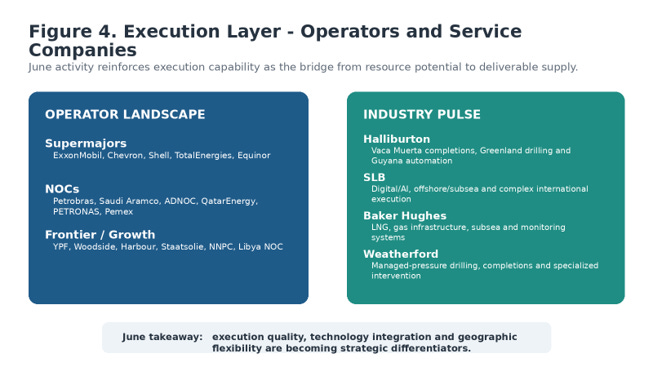
The June operator signal is a growing divide between execution capability and exposure. Operators with diversified portfolios and infrastructure optionality are better positioned to sustain supply confidence, while operators concentrated in sanctions-sensitive or high-risk geographies face uncertainty around continuity, logistics, and market access.
Operator Landscape – Key Signals
ExxonMobil – Offshore execution leadership through Guyana and continued relevance across U.S. Gulf and gas-linked portfolios.
Petrobras – Brazil deepwater anchor through FPSOs, drilling, pre-salt investment, and Santos Basin execution.
Chevron – Expanded relevance across Vaca Muerta, the U.S. Gulf, Venezuela-linked operations, and potential Iraq exposure.
Shell / TotalEnergies – Diversified LNG, offshore, frontier, and gas-linked positioning across multiple First Watch markets.
ADNOC / Saudi Aramco / QatarEnergy – Gulf NOCs shaping supply through investment, route security, gas/LNG, and strategic repositioning.
PETRONAS / ONGC / CNPC / Sinopec / CNOOC – Asian NOC activity remains central to gas, domestic production, and energy security.
Pemex / Ecopetrol / NNPC / Libya NOC – National and regional players remain relevant where policy, infrastructure, and institutional stability allow execution.
Operator Landscape Takeaway: Execution capability is becoming a strategic differentiator. The strongest operators convert capital into supply through resilient infrastructure, technical depth, and diversified exposure.
Industry Pulse – Service Execution in a Deliverability Market
The oilfield services sector remains aligned with international execution, offshore complexity, unconventional completions, LNG/gas infrastructure, and digital optimization. June activity reinforces that service demand is strongest where operators are advancing technically demanding projects.
Halliburton stands out through its unconventional completions exposure in Argentina’s Vaca Muerta, integrated drilling services in Greenland, and automation-related offshore collaboration in Guyana. These signals connect completions efficiency, international deployment, and digital drilling execution.
SLB remains positioned as the technology and integration leader, with relevance across digital, AI-enabled subsurface workflows, offshore/subsea execution, well intervention, managed pressure, and complex international projects. Its strongest signal is the link between digital intelligence and field execution.
Baker Hughes continues to support the gas, LNG, subsea, and infrastructure layer. Its relevance is strongest where LNG, gas value chains, monitoring systems, turbines, compressors, and offshore support intersect with long-cycle project execution.
Weatherford remains important in specialized well services, managed-pressure drilling, completions, and intervention. Its profile is more selective than the larger service leaders, but June activity supports its position in complex international wells and production-focused operations.
Industry Pulse – Key Signals
Halliburton – Vaca Muerta completions, ZEUS electric frac deployment, Greenland drilling support, and Guyana automation signal strong international execution.
SLB – Digital/AI, subsea/offshore, managed pressure, and complex project execution reinforce technology-led leadership.
Baker Hughes – LNG/gas infrastructure, subsea work, monitoring systems, and integrated well construction support gas-linked growth.
Weatherford – Managed-pressure drilling, completions, intervention, and specialized services sustain selective international momentum.
Industry Pulse Takeaway: Service-sector strength is increasingly selective. Technology integration, field reliability, and complex project execution matter more than broad activity recovery alone.
Global Signals – Price, OPEC+, LNG, Demand and Route Security
June reinforces a global oil and gas system where market behavior is driven by both physical supply and confidence in delivery. Prices moved lower as immediate crisis premium faded, but the underlying system remains sensitive to geopolitics, LNG exposure, OPEC+ decisions, inventories, and shipping routes.
Price structure was the most visible signal. The global market overview input indicates that Brent and WTI declined materially over the month as risk premium faded and investors began to focus on recovery, demand softness, and potential surplus conditions. This supports an editorial shift away from forecasting and toward explaining what factors are driving price behavior.
OPEC+ returned to the center of supply interpretation. The production increase decision, demand revisions, and recovery expectations make producer coordination a key market variable. The question is not only how much supply is announced, but how much can physically return to market and how quickly.
LNG deliverability remains strategic. Qatar exposure, Gulf shipping, Asian demand, European storage, U.S. LNG expansion, and gas infrastructure all reinforce the core First Watch theme: gas supply confidence depends on the full delivery chain, not only reserves or nameplate liquefaction capacity.
Shipping and chokepoints remain critical. Hormuz, Red Sea, Black Sea, Caspian, Ceyhan, Fujairah, Yanbu, and LNG shipping lanes all illustrate that infrastructure and route optionality are now market signals. The ability to bypass, reroute, or insure flows is becoming part of supply confidence.
Global Signals – Key Indicators
Oil prices – June shifted from early-month stress toward lower risk premium and recovery pricing.
Supply / demand – Supply recovery and softer demand revisions increased attention to possible surplus conditions.
OPEC+ – Production decisions and compliance remain central to market balance and spare-capacity interpretation.
LNG / gas – Deliverability, shipping, storage, and regional exposure remain key to gas supply confidence.
Rig count / drilling – Activity remains selective, with international/offshore and complex projects showing stronger relevance than broad recovery.
Inventories / storage – Stock movements and storage adequacy remain important for price resilience and demand signals.
Maritime routes – Chokepoints and insurance/logistics risk remain central to physical deliverability.
Geopolitics – Iran, Russia, Gulf producers, sanctions, and conflict risk continue to shape event-driven volatility.
Global Signals Takeaway: The global market is not risk-free; it is repricing risk. Strategic interpretation should focus on the balance between risk premium, supply recovery, demand softness, and deliverability confidence.
Closing Signals – Deliverability as Execution Advantage
The July 2026 Issue closes with a clearer view of a market transitioning from acute disruption toward selective confidence. The system is not simply returning to normal; it is being remeasured through the lens of deliverability.
Capacity, reserves, and project announcements remain important, but they are no longer sufficient. The market is increasingly focused on whether supply can move through secure routes, infrastructure, operators, service capacity, and policy frameworks without interruption.
For producers, the strongest positioning belongs to those with resilient infrastructure, diversified routes, and credible execution. For operators, the advantage lies in converting capital into field progress. For service companies, the opportunity is tied to technology, integration, and complex delivery. For buyers, the strategic question is whether supply is available, movable, and reliable.
This is the defining First Watch signal for July: deliverability is no longer a background assumption. It is the central measure of strategic confidence.
Final Editorial Signal: In a market where risk premium can rise and fall quickly, durable confidence comes from producers, operators, and service partners that can convert capacity into deliverable supply.
Closing Notes
Prepared by Santiago Estefania
First Watch Energy
This edition is based on publicly available information, official data, company disclosures, market reports, industry publications, and First Watch Energy editorial analysis available for the June 1–30, 2026 coverage period.
The July 2026 Issue reflects analysis and interpretation of global oil and gas developments, strategic signals, market indicators, operator activity, service company positioning, LNG deliverability, route security, and broader supply confidence themes.
This publication is intended to provide strategic context and support professional understanding of current developments across the global oil and gas sector.
It does not constitute investment advice, commercial recommendation, trading guidance, or official corporate guidance.
Sources & Validation Framework
This edition is informed by country-level research, international service company activity, global market indicators, official data, company disclosures, and industry reporting for June 1–30, 2026.
High-impact claims should be reviewed against primary or reputable sources, including official company releases, national energy ministries, regulators, OPEC/OPEC+, IEA, EIA, Baker Hughes rig count data, recognized financial and energy news services, and operator disclosures.
Special validation priority applies to price levels, OPEC+ production decisions, Strait of Hormuz and other chokepoint claims, Iran/Russia sanctions, Qatar LNG force majeure, Kuwait/Iraq export recovery, UAE/OPEC status, and major contract values or project dates.