


In a disruption-shaped oil and gas market, reliability is no longer a background condition. It is becoming a strategic asset.
The May 2026 edition of First Watch Energy identified a clear shift in the global system: markets are moving from concentrated disruption toward strategic repositioning. Producers, operators, infrastructure systems, and service companies are no longer simply reacting to supply risk. They are reorganizing around it.
This matters because energy security is no longer defined only by available reserves, production capacity, or headline supply volumes. It is increasingly defined by the ability to convert capacity into deliverable supply under pressure.
That is where the Atlantic Basin becomes strategically important.
In this analysis, the Atlantic Basin is used as a strategic energy-system concept rather than a strict geological definition. It refers to Atlantic-facing and Atlantic-linked producers across the Americas and the North Atlantic that contribute to supply reliability, export flexibility, offshore execution, infrastructure resilience, and market confidence.
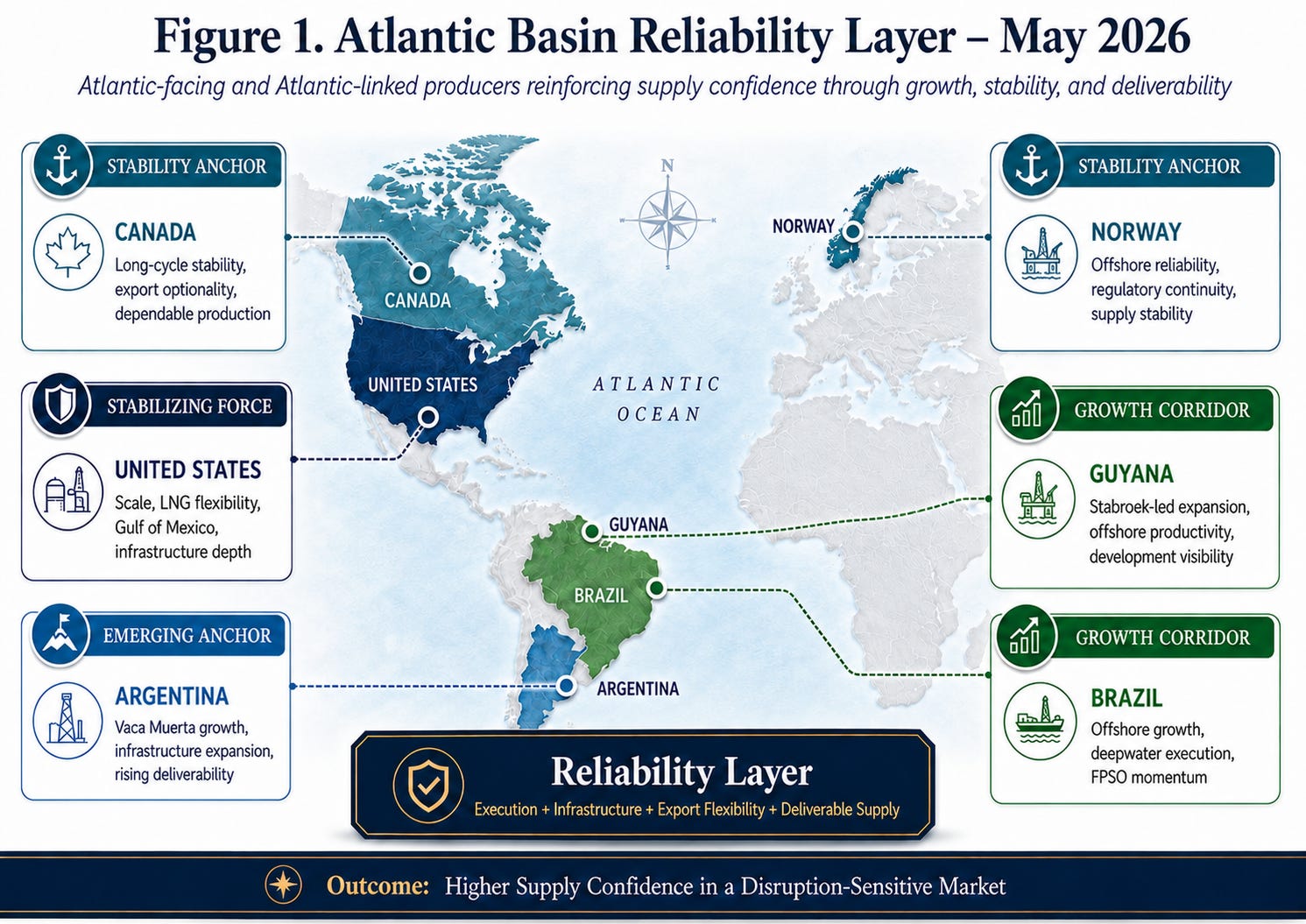
Seen through that lens, Brazil, Guyana, the United States, Argentina, Canada, and Norway form a reliability layer within the broader global oil and gas system. These markets do not eliminate risk, but they offer something increasingly valuable in a volatile environment: execution visibility, operator depth, infrastructure continuity, and a stronger ability to sustain delivery when disruption affects other parts of the supply map.
Reliability is becoming an execution advantage
For much of the global oil and gas market, supply analysis has traditionally centered on volume. Who has the reserves? Who can produce more? Who has spare capacity? Who can respond quickly?
Those questions still matter. But they are no longer enough.
In a system shaped by route security, LNG deliverability, sanctions, infrastructure vulnerability, shipping exposure, and regional instability, the critical question becomes more practical:
Can the supply actually reach the market?
This is where reliability becomes an execution advantage. A producer with large reserves but weak infrastructure, unstable export routes, or high political exposure may have capacity on paper but limited supply credibility. By contrast, producers with consistent execution, resilient infrastructure, and clear operator momentum can support market confidence even if they are not always the largest source of global volume.
The Atlantic-linked supply system matters because it combines growth, maturity, infrastructure, and technical execution across multiple producing centers. It is not a single basin in the geological sense. It is a connected reliability layer across the Americas and the North Atlantic.
That distinction is important. The market does not only need barrels or molecules. It needs barrels and molecules that can be developed, transported, exported, and delivered with confidence.
Brazil and Guyana define the growth corridor
Brazil and Guyana remain central to the Atlantic Basin growth story.
Brazil continues to represent one of the most important offshore execution platforms in the global market. Petrobras-led investment, deepwater development, FPSO activity, and continued basin expansion reinforce Brazil’s role as a dependable growth engine. Its strategic value lies not only in production potential, but in demonstrated offshore execution.
Guyana adds a different but highly complementary signal. The Stabroek Block continues to define one of the most visible offshore growth stories in the world. FPSO-led development, high-performing offshore production, and continued operator confidence strengthen Guyana’s role as a forward-looking supply contributor.
Together, Brazil and Guyana form the strongest growth corridor within the First Watch Boardroom Focus group. They represent the part of the system where offshore expansion remains active, capital continues to move, and operator-led development provides visibility into future supply.
In a market where uncertainty often dominates the narrative, Brazil and Guyana provide a more constructive signal: growth is still happening, but it is becoming more selective and more dependent on execution quality.
The United States remains the stabilizing force
The United States continues to serve as a stabilizing force in the global oil and gas system.
Its role is not limited to crude oil. U.S. supply relevance is supported by steady output, Permian activity, Gulf of Mexico execution, natural gas production, LNG export capacity, and midstream depth. This combination gives the United States a broad market-balancing role across oil, gas, LNG-linked dynamics, and infrastructure-driven supply continuity.
In the current environment, the United States matters because it provides scale with operational depth. It is one of the few markets capable of influencing global balances while maintaining a relatively strong execution base.
That does not mean the U.S. is free of constraints. Capital discipline, infrastructure bottlenecks, regulatory debates, project timelines, and market cycles still matter. But compared with more disruption-exposed regions, the United States continues to provide planning-grade confidence within the broader supply system.
Its strategic value is not only that it produces. It is that it can support multiple layers of market flexibility: crude production, gas production, LNG exports, service capability, technology, infrastructure, and operator scale.
Argentina is moving from opportunity to supply anchor
Argentina’s role is also changing.
For years, Vaca Muerta has been discussed primarily as potential. In the May 2026 First Watch framework, Argentina begins to look less like a distant opportunity and more like an emerging structural supply anchor.
That transition is important.
The country’s relevance is supported by shale development, rig activity, infrastructure expansion, export ambition, and stronger operator participation. The strategic question is no longer whether Argentina has resource potential. It does. The more important question is whether investment, infrastructure, policy support, and operator execution can continue converting that potential into reliable supply.
Argentina is not yet in the same category as the most mature supply anchors. But its trajectory matters. In a system searching for reliable growth outside the most disruption-exposed regions, Argentina provides one of the clearest examples of a market moving from promise toward structural contribution.
Its role is best understood as a bridge: between resource potential and deliverable supply, between domestic development and export relevance, and between frontier ambition and future supply confidence.
Canada and Norway reinforce the stability layer
Canada and Norway provide a different kind of reliability.
Canada reinforces the Atlantic-linked supply layer through long-cycle production stability, disciplined development, infrastructure expansion, and improved export optionality. Its importance is not built on rapid growth alone, but on dependable production and long-term supply visibility.
Norway remains one of the lowest-noise producers in the global system. Its role is supported by regulatory consistency, offshore reliability, licensing activity, mature-field redevelopment, and continued operator discipline across the Norwegian Continental Shelf.
This type of stability is sometimes less dramatic than frontier exploration or geopolitical shock. But for decision-makers, it is extremely important. Reliable, lower-noise producers help create a baseline of confidence in a market where volatility can quickly transmit through exposed infrastructure, shipping routes, sanctions, and regional conflict.
Canada and Norway matter because they help anchor the system. They may not always define the growth narrative, but they strengthen the continuity narrative. In a disruption-sensitive market, that continuity is valuable.
The Atlantic Basin is not risk-free — but it is credibility-rich
The Atlantic Basin should not be misunderstood as a risk-free zone.
Every market in this group has constraints. Brazil must continue executing complex offshore projects. Guyana must manage rapid growth and infrastructure scale-up. The United States faces capital discipline, infrastructure, and regulatory dynamics. Argentina must sustain investment and policy alignment. Canada remains tied to long-cycle economics and export access. Norway must manage mature-field realities and long-term production renewal.
But the key point is not the absence of risk.
The key point is the ability to operate through risk without losing supply credibility.
That is what separates this group from more disruption-exposed producers. In today’s market, reliability does not mean perfection. It means the ability to keep delivering despite pressure. It means infrastructure that can support continuity. It means operators with capital discipline and technical depth. It means regulatory environments that allow projects to move. It means export systems that can connect production to demand.
In that sense, the Atlantic Basin is becoming more than a geography. It is becoming a reliability layer.
Why this matters for strategic positioning
For operators, service companies, investors, and policy stakeholders, the implication is clear: strategic positioning should increasingly prioritize producers and basins that combine resource potential with execution credibility.
The strongest opportunities are not always found where the resource base is largest. They are found where production, infrastructure, operator capability, export optionality, and policy alignment come together.
This is why the Atlantic Basin matters.
It offers a counterweight to disruption-sensitive regions. It supports supply confidence in an increasingly event-driven market. It provides both growth corridors and mature stability. And it reinforces a central First Watch signal for May 2026:
Capacity alone is no longer sufficient.
In the next phase of the oil and gas market, confidence will depend on deliverability. The Atlantic Basin and its Atlantic-linked producers are becoming one of the clearest places where that deliverability can still be seen, tested, and expanded.
The question will not only be who has supply.
It will be who can deliver it with confidence.