


In today’s oil and gas market, capacity is no longer the same as confidence.
For years, market analysis has often centered on how much supply exists, how much production can be added, where reserves are located, and which producers have the ability to increase output. Those questions still matter. But in a disruption-sensitive system, they are no longer enough.
The May 2026 edition of First Watch Energy highlighted a structural shift in the global oil and gas landscape: markets are moving from concentrated disruption toward strategic repositioning. Producers, operators, infrastructure systems, and service companies are increasingly being evaluated not only by the scale of their resources, but by their ability to convert those resources into supply that can actually reach the market.
That distinction is becoming increasingly important.
Capacity is potential.
Deliverable supply is confidence.
Capacity on paper is not the same as supply in motion
Oil and gas markets have always made a distinction between resources, reserves, production capacity, and actual market supply. But today that distinction has become more strategic.
Capacity on paper may exist in the form of reserves, project pipelines, announced production targets, spare capacity, LNG expansion plans, or infrastructure commitments. It can appear strong in headline numbers, investor presentations, national energy strategies, or long-term development plans.
But supply in motion requires more.
It requires wells that can produce, infrastructure that can process, pipelines that can transport, terminals that can export, shipping routes that can remain open, buyers that can receive, and operators that can execute under pressure.
In a stable market, the gap between capacity and deliverability can appear manageable. In a disrupted market, that gap becomes central.
A producer may have resources but limited export flexibility. A project may have strong economics but weak infrastructure access. A country may have production capacity but face sanctions, route exposure, financing constraints, or political instability. An LNG supplier may have gas reserves but lack timely liquefaction capacity, shipping availability, or reliable access to end markets.
This is why capacity alone is no longer sufficient.
The market is increasingly asking a different question:
Can the supply actually move?
Disruption changes the meaning of supply
The current oil and gas system is shaped by a growing number of pressure points.
Route security, shipping exposure, sanctions, infrastructure vulnerability, LNG deliverability, capital discipline, geopolitical fragmentation, and regional instability are all affecting how markets interpret supply confidence.
In this environment, supply is not only a production issue. It is a system issue.
A barrel or molecule only matters strategically if it can move through the chain from production to market. That chain includes upstream execution, midstream infrastructure, export systems, maritime routes, commercial structures, regulatory continuity, and customer access.
When one part of that chain becomes fragile, capacity loses credibility.
This is especially important in a market where disruption is not isolated to one region or one commodity. Oil flows, LNG cargoes, shipping lanes, offshore projects, sanctions regimes, refinery demand, and infrastructure reliability are increasingly connected. A disruption in one part of the system can quickly affect pricing, availability, risk perception, and strategic positioning elsewhere.
That is why deliverability is becoming a market signal.
It tells decision-makers not only where supply exists, but where supply can continue to function under pressure.
The new hierarchy of confidence
The next phase of market confidence is likely to be shaped by a new hierarchy.
At the top are producers and basins that combine resource depth with execution capability, infrastructure resilience, export flexibility, operator discipline, and stable market access. These suppliers may not always be the lowest-cost or largest by volume, but they offer something increasingly valuable: planning-grade confidence.
In the middle are producers with strong resources but visible bottlenecks. These may include promising supply centers where infrastructure, financing, permitting, political alignment, or export capacity still need to catch up with resource potential.
At the lower end are supplies exposed to sanctions, route insecurity, fragile infrastructure, political instability, or uncertain execution. These producers may still matter to the market, but their capacity is discounted by the risk that supply may not move reliably.
This framework helps explain why the market is paying closer attention to the difference between available supply and deliverable supply.
It is not enough to ask who can produce.
The more strategic question is who can deliver.
LNG makes the issue more visible
LNG is one of the clearest examples of why deliverability now matters as much as capacity.
Gas resources alone do not create supply confidence. LNG requires a full chain of execution: upstream gas production, processing, liquefaction capacity, export terminals, shipping availability, route continuity, receiving terminals, regasification capacity, contracts, and end-market demand.
If one part of that chain becomes constrained, the market impact can be immediate.
This is why LNG has become a strategic lens for understanding the broader oil and gas system. It shows that supply confidence depends not only on molecules, but on infrastructure, logistics, contracts, shipping, and geopolitical access.
The same principle applies across oil markets.
Crude supply also depends on infrastructure, ports, pipelines, storage, tanker availability, routes, sanctions exposure, and buyer confidence. Offshore production depends on project execution, FPSO delivery, subsea capability, service-sector availability, and capital discipline. Shale growth depends on drilling activity, midstream capacity, labor, financing, and market access.
Across the system, the message is the same:
Capacity becomes confidence only when it can move.
Why this matters for operators and service companies
For operators, this shift changes the meaning of strategic advantage.
The strongest positions are no longer defined only by acreage, reserves, or production potential. They are defined by the ability to execute projects, maintain infrastructure continuity, manage logistics, preserve export optionality, and bring supply to market under changing conditions.
This favors companies and regions with strong technical depth, disciplined capital allocation, flexible infrastructure, experienced service providers, and resilient operating models.
It also creates opportunity for service companies.
As supply confidence becomes more dependent on execution, the role of oilfield services, engineering capability, digital monitoring, project management, offshore technology, LNG infrastructure support, and maintenance reliability becomes more strategic.
In a market where deliverability is the signal, execution capability becomes part of the supply story.
Why this matters for investors and policymakers
For investors, the shift from capacity to deliverability changes how risk should be evaluated.
A project with large resources but weak infrastructure may carry more risk than headline reserves suggest. A producer with moderate growth but high execution reliability may provide stronger strategic value than a larger but more exposed supply source.
For policymakers, the lesson is also clear. Energy security is not only about securing volumes. It is about ensuring that supply chains remain functional.
That means infrastructure resilience, route security, regulatory clarity, investment continuity, and export flexibility are becoming part of the energy security equation.
In this environment, the most valuable supply is not simply the supply that exists.
It is the supply that can be trusted to arrive.
From capacity to confidence
The market is not abandoning capacity as a metric. It is adding another layer above it.
Reserves still matter. Production still matters. Spare capacity still matters. Project pipelines still matter.
But they now sit within a broader question of deliverability.
Can the supply be developed?
Can it be transported?
Can it be exported?
Can it reach demand centers?
Can it withstand disruption?
Can operators execute consistently?
Can infrastructure support continuity?
These questions are becoming central to how oil and gas markets evaluate confidence.
This is the emerging First Watch signal:
Capacity is not confidence.
Confidence follows deliverability.
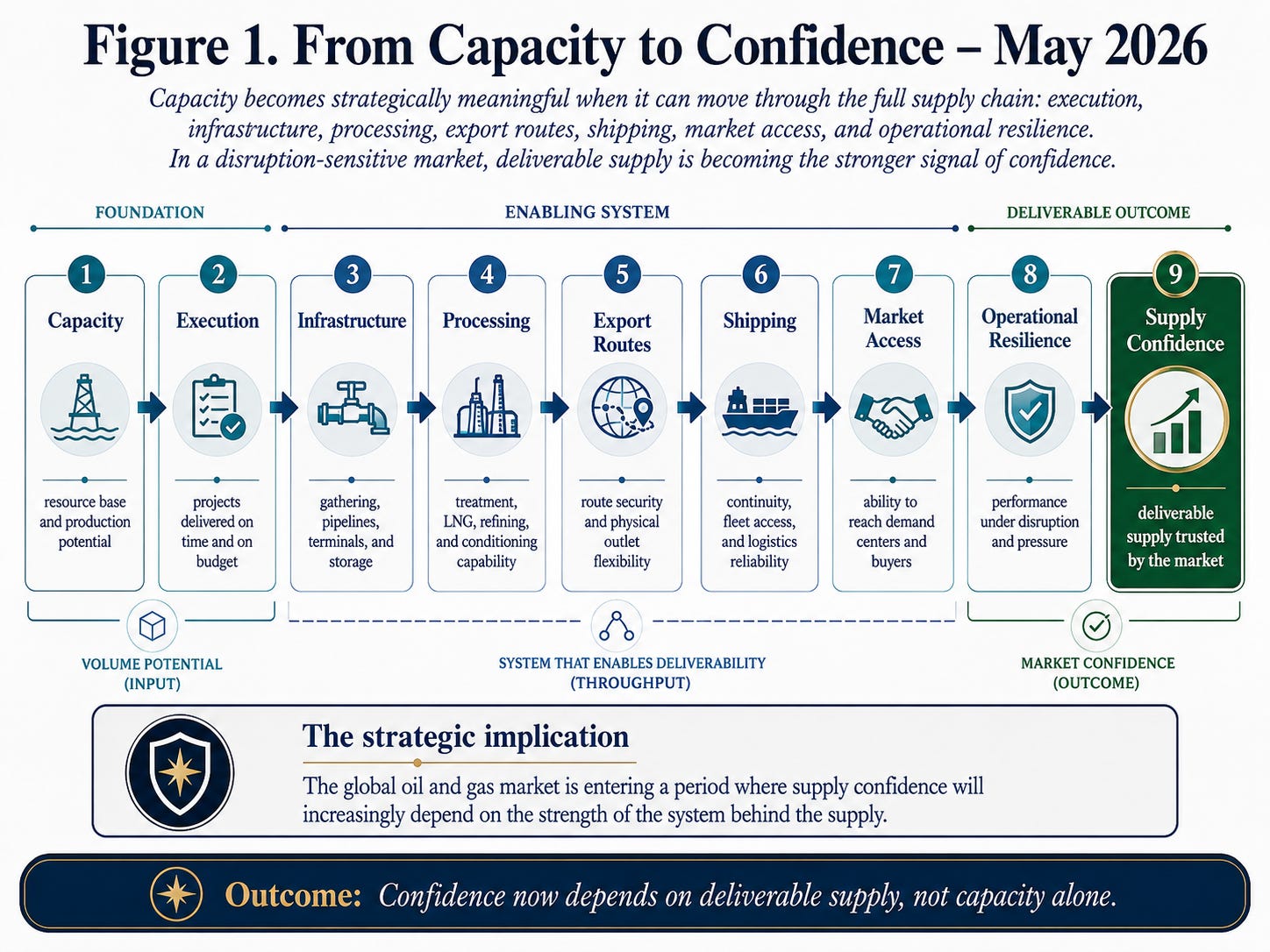
The strategic implication
The global oil and gas market is entering a period where supply confidence will increasingly depend on the strength of the system behind the supply.
This does not mean capacity is irrelevant. It means capacity must be tested against execution, infrastructure, logistics, route exposure, and market access.
The strongest producers, operators, and regions will be those that can combine resource depth with delivery credibility.
The same logic applies to LNG, offshore oil, shale production, midstream infrastructure, export terminals, and long-cycle development. In each case, the question is not only whether supply exists. It is whether supply can move reliably through the system when pressure rises.
That is why deliverability is becoming one of the most important signals in the next phase of the oil and gas market.
The market will still watch production.
It will still watch reserves.
It will still watch capacity.
But confidence will increasingly follow the supply that can be developed, transported, exported, and delivered with reliability.
The question is no longer only who has capacity.
It is who can convert capacity into confidence.