


In today’s gas market, LNG confidence is no longer created at the reservoir.
It is created across the chain that moves supply from the resource base to the final buyer.
That distinction is becoming increasingly important.
For years, LNG growth has often been discussed through the language of capacity: gas reserves, liquefaction projects, export terminals, final investment decisions, long-term contracts, shipping availability, and demand growth. Those metrics still matter. But in a disruption-sensitive energy system, they are no longer sufficient on their own.
The strategic question is shifting.
It is no longer only how much gas exists.
It is whether that gas can be produced, processed, liquefied, loaded, shipped, received, regasified, and delivered reliably to the market.
That is the difference between LNG potential and LNG deliverability.
And that difference is becoming one of the most important signals in global gas supply confidence.
LNG is a chain, not a single asset
LNG is often described as a commodity, but operationally it is a system.
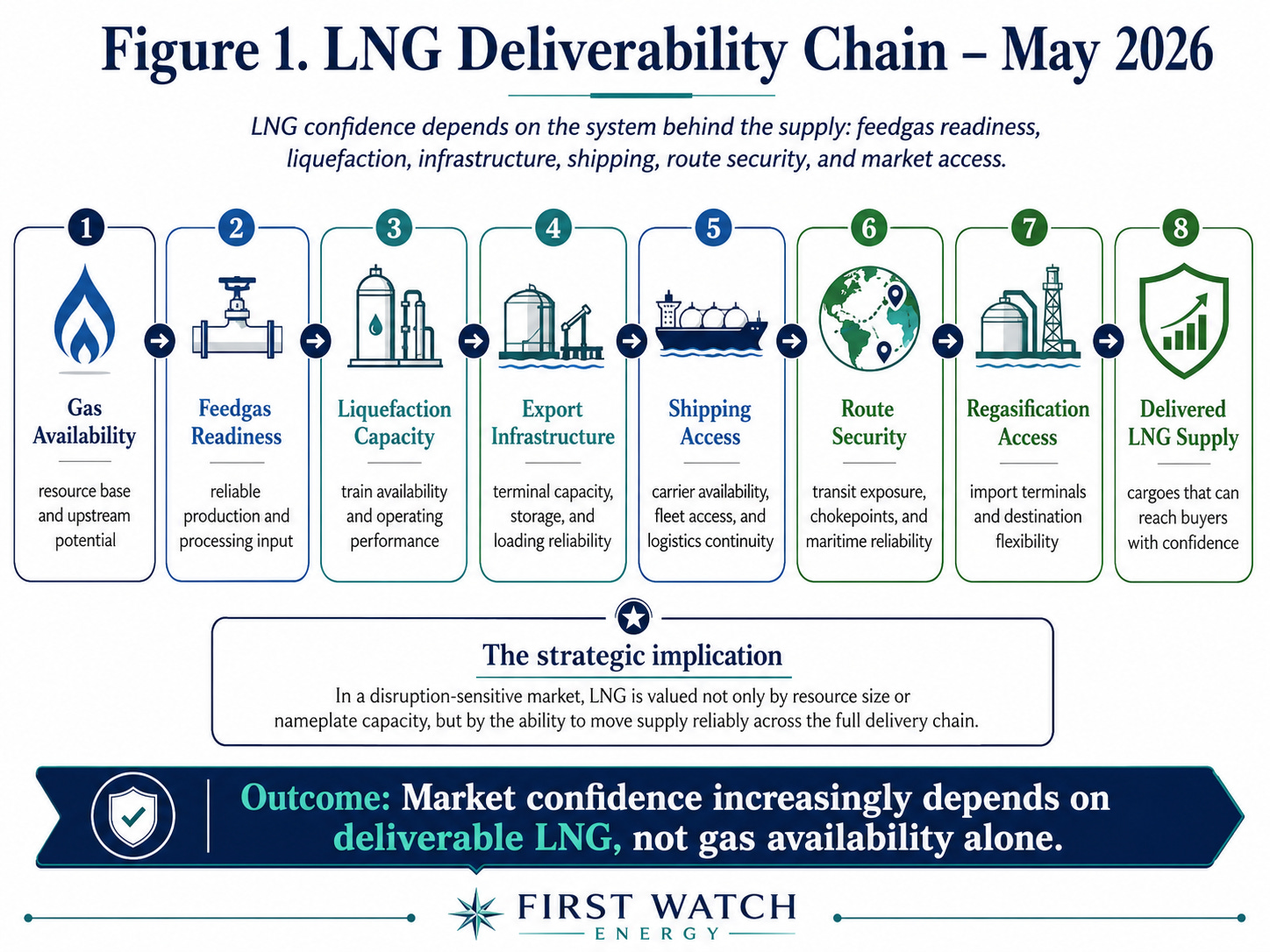
It depends on a long chain of physical, commercial, and geopolitical links. Upstream gas must be available. Feedgas must be processed and delivered to liquefaction plants. Liquefaction trains must operate reliably. Export terminals must remain accessible. LNG carriers must be available. Shipping routes must remain open. Import terminals must have receiving and regasification capacity. Buyers must be able to absorb the cargoes. Contracts, credit, pricing, and market access must align.
Only when that full chain functions does gas become deliverable LNG.
That is why announced capacity does not automatically create supply confidence.
A country may have large gas resources but limited liquefaction capacity. A project may have strong long-term demand but face construction delays. A terminal may be built but depend on constrained feedgas. A cargo may be available but exposed to route risk. A buyer may want LNG but lack sufficient regasification access. A producer may have export ambition but face financing, permitting, infrastructure, or geopolitical constraints.
Each of these issues affects market confidence.
In oil markets, supply confidence often depends on production, infrastructure, storage, export routes, and buyer access. In LNG, that logic is even more visible because the chain is more complex, more capital intensive, and more dependent on integrated infrastructure.
LNG does not become strategic simply because gas exists.
It becomes strategic when gas can move.
From gas availability to LNG deliverability
The May 2026 edition of First Watch Energy highlighted a broader market shift from capacity toward deliverability. LNG is one of the clearest examples of that shift.
Gas availability is the starting point. It tells the market that supply potential exists. But availability alone does not answer the most important operational question: can the supply reach customers when it is needed?
Deliverability depends on execution.
It requires upstream development, midstream readiness, liquefaction reliability, terminal infrastructure, maritime logistics, route security, regasification access, and commercial continuity.
That chain converts a resource into a market signal.
When the chain is strong, LNG supports supply confidence. When the chain is weak, capacity becomes discounted. The market may still recognize the long-term potential, but it will assign less confidence to the supply until the bottlenecks are resolved.
This is why LNG project timing, infrastructure execution, shipping availability, and route exposure matter so much.
A liquefaction project delayed by construction or regulatory issues affects future supply confidence. Feedgas constraints can limit utilization even when liquefaction capacity exists. Shipping disruptions can alter cargo flows. Route insecurity can increase costs and uncertainty. Import infrastructure constraints can limit demand absorption. Contracting gaps can reduce financing visibility.
Each point in the chain can either strengthen or weaken the credibility of LNG supply.
Where the system becomes fragile
LNG markets are particularly exposed to disruption because they depend on both fixed infrastructure and mobile logistics.
Liquefaction terminals are fixed assets. Export ports are fixed assets. Receiving and regasification terminals are fixed assets. Shipping routes, however, move through a changing geopolitical environment.
That combination creates strategic sensitivity.
The system may look strong on paper, but actual deliverability can be affected by several pressure points:
upstream gas availability;
feedgas infrastructure constraints;
liquefaction delays or outages;
export terminal bottlenecks;
LNG carrier availability;
shipping-route exposure;
canal, strait, or chokepoint disruption;
sanctions or trade restrictions;
regasification access;
buyer credit and contract flexibility;
weather, maintenance, or operational interruption.
In a stable environment, these risks may appear manageable. In a disruption-sensitive environment, they become part of the market’s assessment of supply confidence.
This is why LNG is increasingly evaluated not only by nameplate capacity, but by reliability across the full system.
A new LNG project may add future supply potential, but markets still need to know whether it can be built on time, supplied with feedgas, operated consistently, and connected to buyers through resilient routes and infrastructure.
That is the difference between announced supply and deliverable supply.
Route security is now part of LNG confidence
Route security has become a central part of LNG market analysis.
Unlike pipeline gas, LNG depends on maritime movement. Cargoes can be flexible, but they are also exposed to shipping costs, transit delays, chokepoints, insurance risk, rerouting, sanctions, and geopolitical pressure.
This flexibility is one of LNG’s strengths. Cargoes can move across regions and respond to changing demand. But flexibility does not eliminate risk. It shifts part of the supply-confidence question from production and infrastructure to maritime logistics.
In a more fragmented geopolitical environment, route exposure becomes part of the value chain.
The market does not only ask whether LNG can be produced. It asks whether cargoes can move safely, predictably, and economically to demand centers.
This is especially important when LNG is being used as a tool of energy security.
For importing countries, LNG provides diversification. For exporting countries, LNG provides market access. For operators, LNG creates long-term growth opportunities. But for all of them, the value of LNG depends on continuity.
A cargo that cannot move does not strengthen energy security.
A project that cannot reach buyers does not fully support market confidence.
A route that becomes unstable can quickly change the economics and reliability of supply.
That is why route security now belongs inside the LNG deliverability framework.
Infrastructure is becoming a strategic signal
Infrastructure is no longer just a technical detail in LNG markets.
It is becoming a strategic signal.
The countries and operators that can combine gas resources with liquefaction capacity, export infrastructure, shipping continuity, and market access are better positioned to provide confidence in a disrupted system.
This gives an advantage to supply sources with visible execution capability and reliable infrastructure. It also increases the importance of project delivery, construction discipline, terminal uptime, maintenance performance, and integration across the value chain.
For buyers, infrastructure reliability matters because it affects procurement confidence. For sellers, it matters because it affects market credibility. For investors, it matters because it affects project risk. For policymakers, it matters because it affects energy security.
In this environment, LNG infrastructure is not only a commercial asset.
It is part of the reliability architecture of the global gas system.
That architecture includes export terminals, liquefaction trains, pipelines, storage, shipping, regasification terminals, and the contractual frameworks that allow supply to move.
When those elements are aligned, LNG becomes a stronger source of confidence.
When they are misaligned, LNG capacity becomes more uncertain.
Why this matters for operators and service companies
For operators, the shift toward deliverability changes the meaning of competitive strength.
It is not enough to hold gas resources or announce LNG capacity. Operators must demonstrate that projects can be executed, integrated, commissioned, supplied, and operated reliably.
This places a premium on execution capability.
Major LNG developments require engineering depth, project management, construction discipline, technology integration, upstream coordination, midstream reliability, and long-term operational control. Delays, cost inflation, contractor constraints, technical problems, or feedgas uncertainty can weaken confidence even before a project reaches full operation.
For service companies, this creates an important opportunity.
As LNG confidence becomes more dependent on execution, the role of engineering, construction, digital monitoring, equipment reliability, maintenance, subsea capability, compression, processing, and project services becomes more strategic.
The LNG system needs more than resource ownership.
It needs execution capacity.
It needs infrastructure reliability.
It needs operational resilience.
That makes service-sector capability part of the LNG supply-confidence story.
Why this matters for buyers and policymakers
For buyers, LNG deliverability affects energy-security planning.
A contract is only as reliable as the system that supports delivery. Buyers must evaluate not only price and volume, but also source reliability, shipping exposure, terminal access, route risk, and supplier execution capability.
For policymakers, LNG deliverability has become part of national energy strategy.
Countries seeking supply security must look beyond headline capacity and assess whether the full delivery chain is resilient. That includes import terminal capacity, regasification access, storage, pipeline connections, contractual flexibility, and exposure to maritime disruption.
Energy security is no longer only about securing volumes.
It is about securing reliable flows.
That distinction is especially important when LNG is expected to support power generation, industrial demand, heating, energy transition flexibility, and diversification away from less reliable sources.
In this context, LNG confidence becomes a function of system strength.
The strategic implication
LNG is becoming one of the clearest examples of a broader market shift.
Capacity still matters.
Gas resources still matter.
Liquefaction projects still matter.
Long-term contracts still matter.
But the strongest market signal is increasingly deliverability.
The market wants to know whether supply can move through the full chain and reach demand centers under pressure.
That is why LNG confidence now depends on infrastructure, routes, and execution. The next phase of LNG competitiveness will not be defined only by who has gas or who announces capacity. It will be defined by who can reliably convert gas into delivered supply.
This is the emerging signal:
Gas resources create potential.
LNG capacity creates optionality.
LNG deliverability creates confidence.
In a disruption-shaped energy system, the question is no longer only who has gas.
It is who can move it reliably to the market.